
The Two Beasts
Paul Bernard
Revelation 13 warns that every age produces its own “beasts” — systems, governments, movements, or ideologies that promise peace but demand worship. Christians are called not to fear them, nor to bow to them, but to remain faithful to the Lamb, “for their names are written in the book of life” (Rev. 13:8).
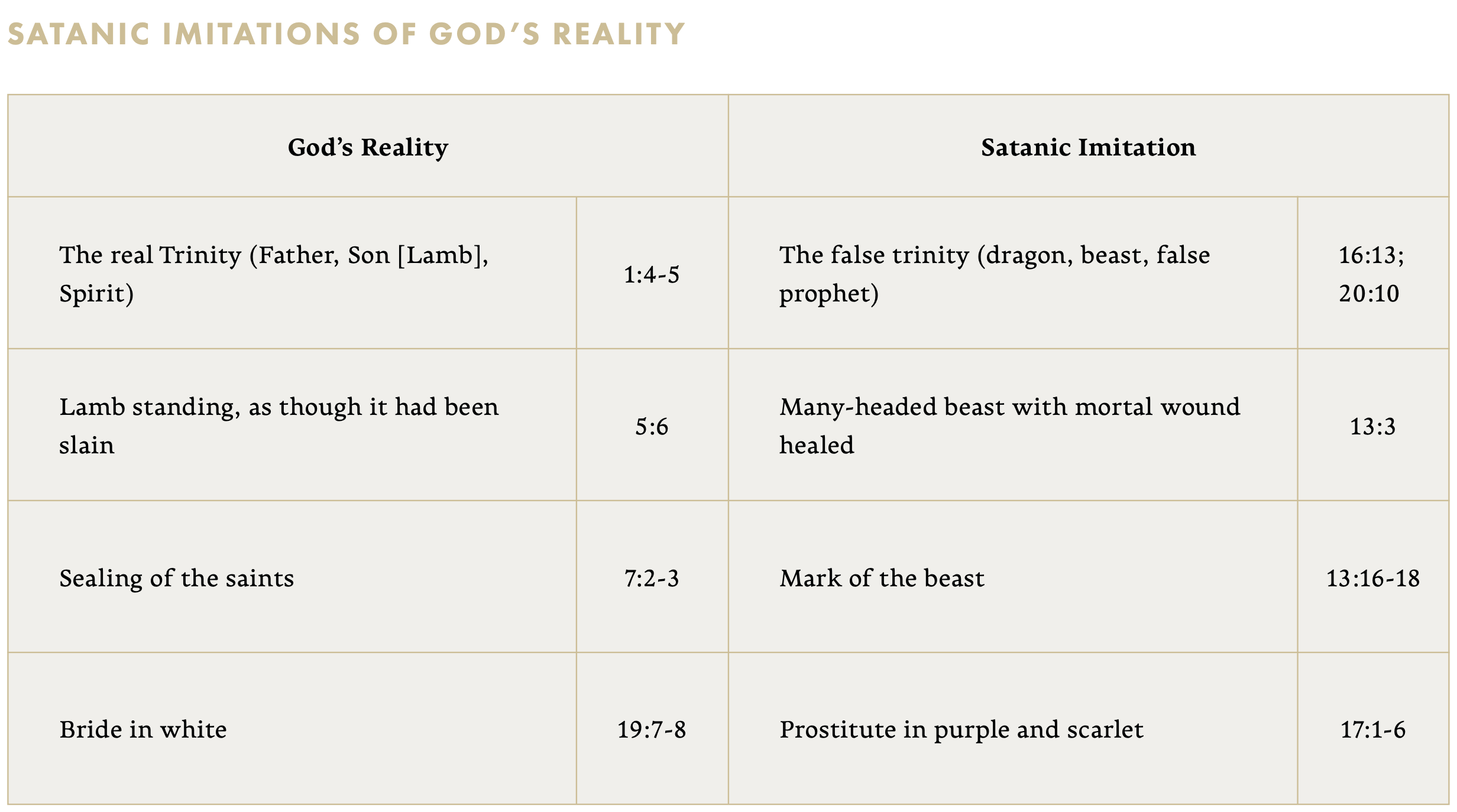
Some believe that the beasts fall into the larger context of “The Unholy Trinity” in Revelation 12 & 13. That the dragon of Revelation 12 is the counterfeit Father, the Beast from the Sea in Revelation 13:1-10) is the counterfeit Son and the Beast from the Earth in Revelation 13:11-18 is the counterfeit Spirit enforcing false worship. Together they form a parody of the Trinity, waging war against His followers (Rev. 12:17; 13:7–8). (see ESV Chart “Satanic Imitations of God’s Reality” Below)
I. The First Beast – From the Sea (Revelation 13:1–10)
Revelation 13:1 “And I saw a beast rising out of the sea, with ten horns and seven heads, with ten diadems on its horns and blasphemous names on its heads.”
Biblical Description
Rises from the sea (v.1): Symbolic of chaos, the nations, or the realm of evil (Daniel 7:2–3; Isaiah 57:20).
Seven heads and ten horns: Represents a coalition of worldly powers (Daniel 7:7–8, 23–25).
Composite beast (leopard, bear, lion) (v.2): Evokes Daniel 7’s sequence of empires (Babylon, Persia, Greece, Rome).
Given power by the dragon (v.2): The dragon of Revelation 12 (Satan) empowers human empires.
Suffers a mortal wound, yet lives (v.3): A parody of Christ’s death and resurrection, a “counterfeit savior.”
Blasphemes God and persecutes the saints (v.5–7): Political or cultural power demanding divine allegiance.
Rules for forty-two months (v.5): Symbolic of a limited, divinely bounded period of evil (Rev. 11:2–3; Dan. 7:25).
Interpretive Frameworks
Preterist: The beast represents the Roman Empire, especially under Nero. The “mortal wound” alludes to Nero’s death and the myth of his return. Emperor worship is in view.
Historicist: The beast symbolizes oppressive political systems across history, often identified with imperial and papal Rome.
Futurist: A future global empire or the Antichrist who will dominate the world at the end of the age.
Idealist: The beast represents any recurring manifestation of godless political power that demands ultimate loyalty—totalitarian states, oppressive ideologies, and empires that stand against Christ.
Commentary
G.K. Beale (The Book of Revelation): “The beast from the sea is not one individual ruler but the embodiment of all ungodly political power throughout history, animated by Satan himself.”
Robert H. Mounce (The Book of Revelation): “John’s readers would have recognized in the beast the image of imperial Rome, whose authority was absolute and whose emperor claimed divine honors.”
Craig S. Keener (Revelation): “The beast parodies the Lamb—its power comes from the dragon, not from God. The political state here becomes idolatrous, demanding worship.”
N.T. Wright (Revelation for Everyone): “This monster is empire itself—always arising from the chaos of human rebellion, claiming to bring order, peace, and salvation, but in reality feeding on domination and fear.”
II. The Second Beast – From the Earth (Revelation 13:11–18)
Revelation 13:11 “Then I saw another beast rising out of the earth. It had two horns like a lamb and it spoke like a dragon.”
Biblical Description
From the earth (v.11): More local or religious in function than the first beast.
Like a lamb, speaks like a dragon: Appears gentle and Christlike but speaks satanic lies.
Exercises the authority of the first beast (v.12): Enforces worship of worldly power.
Performs great signs (v.13–14): Counterfeit miracles deceiving people (cf. 2 Thess. 2:9–10).
Forces worship and the mark of the beast (v.15–18): The “mark” symbolizes allegiance—economic and spiritual loyalty to the beast’s system.
Interpretive Frameworks
Preterist: The second beast represents the provincial priesthoods of the Roman Empire that enforced emperor worship and maintained political control through religion.
Historicist: Symbolizes false religion allied with political power—often seen as the papal or ecclesiastical authority of the Middle Ages.
Futurist: A future false prophet who performs miracles and compels worship of the Antichrist.
Idealist: Symbolizes false ideology, propaganda, or deceptive spirituality—any system that persuades people to give ultimate allegiance to the state or to self rather than to Christ.
Commentary
G.K. Beale: “The second beast is the propagandist for the first, a symbol of false religion and deceptive ideology supporting idolatrous power.”
Mounce: “He is the religious face of secular authority—a lamb that speaks like a dragon, deceiving the nations in the name of worship.”
Grant Osborne: “The second beast completes the satanic counterfeit of the Trinity; he plays the role of the Spirit, pointing to and glorifying the first beast.”
N.T. Wright: “This is propaganda—religious, cultural, economic, whatever form it takes—that makes people think the monster from the sea deserves their loyalty.”
Revelation 13 warns that every age produces its own “beasts” — systems, governments, movements, or ideologies that promise peace but demand worship. Christians are called not to fear them, but to remain faithful to the Lamb, “for their names are written in the book of life” (Rev. 13:8).
Bibliography
Beale, G.K. The Book of Revelation. New International Greek Testament Commentary. Grand Rapids: Eerdmans, 1999.
Mounce, Robert H. The Book of Revelation. New International Commentary on the New Testament. Grand Rapids: Eerdmans, 1997.
Osborne, Grant R. Revelation. Baker Exegetical Commentary on the New Testament. Grand Rapids: Baker Academic, 2002.
Keener, Craig S. Revelation. NIV Application Commentary. Grand Rapids: Zondervan, 2000.
Wright, N.T. Revelation for Everyone. Louisville: Westminster John Knox, 2011.
Ladd, George Eldon. A Commentary on the Revelation of John. Grand Rapids: Eerdmans, 1972.
Swete, Henry Barclay. The Apocalypse of St. John. London: Macmillan, 1911.
Poythress, Vern S. The Returning King: A Guide to the Book of Revelation. Phillipsburg: P&R Publishing, 2000.
Caird, G.B. A Commentary on the Revelation of St. John the Divine. London: A&C Black, 1966.